Running on worn-out shoes is one of the most overlooked causes of injury. Studies show that most runners replace their shoes way too late, and buying used running shoes without checking their condition first makes things worse.
If you’ve ever wondered why your knees ache or your shins hurt after a run, the answer might be sitting right on your feet.
What injuries do worn running shoes actually cause?
Worn midsoles and collapsed heel cushioning don’t just feel uncomfortable — they put real stress on your body. When the foam in a shoe breaks down, your joints absorb the impact that the shoe used to handle.
Here’s what that leads to:
Plantar fasciitis is one of the most common complaints. The plantar fascia — the band of tissue along the bottom of your foot — gets overloaded when a shoe’s arch support is gone. Research from the American Podiatric Medical Association links poor footwear support directly to this condition.
Shin splints happen when the muscles along your shinbone get overworked, often because the shoe’s cushioning has broken down and your leg has to work harder on impact.
IT band syndrome is another one. When a shoe’s midsole wears unevenly, it tilts your foot inward or outward slightly. That small tilt travels up your leg and irritates the iliotibial band, causing pain on the outside of your knee.
Stress fractures are the worst-case outcome. A 2019 study published in the British Journal of Sports Medicine found that inadequate footwear cushioning was a contributing factor in roughly 30% of lower limb stress fractures among recreational runners.
How many miles are too many on a used pair?
Most running shoes are built to last between 300 and 500 miles. After that, the midsole foam — which is the real shock absorber, not the outsole rubber — starts breaking down significantly.
The problem with used running shoes is that you rarely know how
many miles the previous owner put on them. Someone might have run 400 miles in a pair and the outsole still looks clean, but the foam inside is basically flat.
Here’s a rough way to think about it:
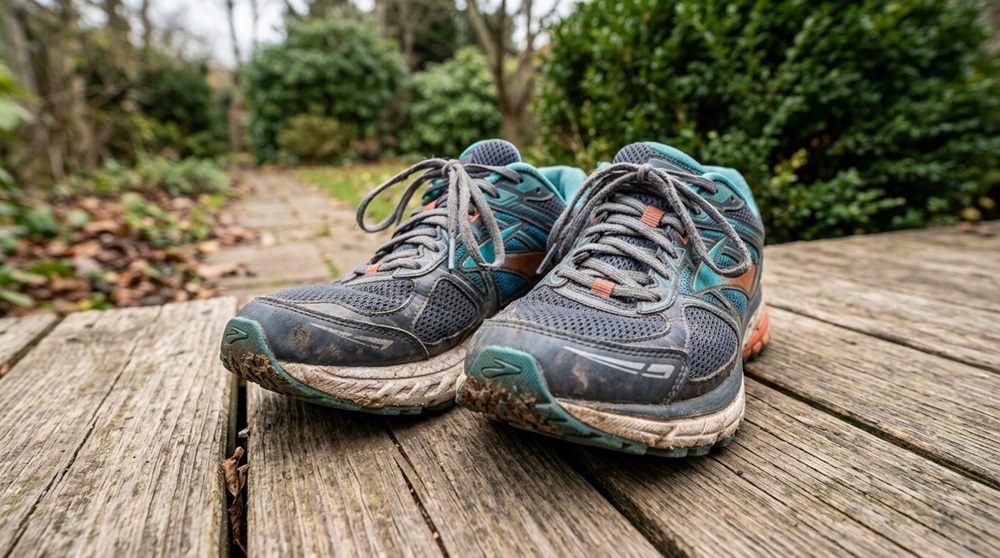
If a shoe looks barely worn on the outside but feels soft and squishy when you press the midsole, that’s actually a sign it’s been used heavily. Fresh foam bounces back quickly. Dead foam stays compressed.

What to check before buying used running shoes
You don’t need any tools for this. Just your hands and eyes.
First, look at the heel counter — the firm cup at the back of the shoe. Press on it from the outside. If it collapses easily or feels soft, the shoe has lost structural integrity. A healthy heel counter should feel stiff and firm.
Second, bend the shoe from toe to heel. A good shoe flexes at the ball of the foot, not in the middle. If it bends easily in the middle, the midsole is done.
Third, set the shoe on a flat surface and look at it from behind. If it leans inward or outward, the midsole has compressed unevenly. Running in a shoe that leans will throw off your gait immediately.
Fourth, press your thumb firmly into the midsole foam on the side of the shoe. It should push back with some resistance. If your thumb sinks in easily, the cushioning is gone.
Used running shoes and your gait – what changes
When a shoe’s cushioning breaks down, your body compensates without you even knowing it. You might start landing harder on your heel, or your knee might rotate inward slightly on each step. These small changes add up fast.
A 2021 study in the Journal of Biomechanics found that runners showed measurable changes in knee loading within just two weeks of switching to worn footwear. That’s fast enough to cause real damage before you even feel pain.