

The most useful scrub accessories are the ones that improve organization, comfort, identification, storage, or layering without adding unnecessary bulk to a healthcare uniform. Depending on the role, practical options can include badge holders, scrub bags, stethoscope cases, underscrubs, jackets, pocket organizers, work socks, and other workplace-approved items.
Healthcare professionals should choose accessories according to what they actually carry, how they move throughout a shift, and what their facility permits. An accessory should simplify the workday rather than create additional weight, clutter, contamination concerns, or interference with required clinical procedures.
Quick Answer
Useful scrub accessories may include:
- Badge holders or retractable badge reels
- Scrub bags or medical work bags
- Stethoscope carrying cases
- Pocket organizers
- Pen holders
- Scrub jackets
- Underscrub layers
- Work socks
- Small personal-item organizers
- Workplace-approved head coverings
- Secure key or card holders
Before purchasing an accessory, ask:
- Is it permitted by the workplace?
- Does it solve an actual problem?
- Can it be cleaned or maintained appropriately?
- Will it interfere with hand hygiene or PPE?
- Is it secure during bending and walking?
- Does it create unnecessary pocket weight?
- Can essential items be reached quickly?
Healthcare accessories should support the uniform, not turn it into an overloaded storage system.
What Counts as a Scrub Accessory?
A scrub accessory is an item used alongside medical workwear to improve organization, comfort, identification, storage, or layering.
Common examples include:
- Badge reels
- Identification holders
- Work bags
- Backpacks
- Stethoscope cases
- Pocket organizers
- Scrub jackets
- Underscrubs
- Socks
- Hair coverings
- Small utility organizers
- Key holders
Some accessories are worn directly with the uniform. Others are used to transport work items between home, lockers, classrooms, clinical sites, or other approved storage areas.
Healthcare professionals browsing medical scrubs and accessories should start by separating genuinely useful work items from accessories that merely add clutter.
Which Scrub Accessories Are Actually Essential?
There is no universal checklist.
A nurse working on a hospital floor may need a very different accessory setup from:
- A physician working primarily in a clinic
- A dental assistant
- A veterinary technician
- A nursing student
- A medical assistant
- A home-health professional
The most practical accessory system depends on:
- Job responsibilities
- Workplace policy
- Available storage
- Required identification
- Uniform requirements
- Work environment
- Shift length
- Personal organization preferences
The goal is not to carry the maximum number of accessories.
It is to keep necessary items organized while minimizing weight and interference.
Why Is a Badge Holder Important?
Healthcare professionals frequently need visible identification.

A badge holder keeps an identification card accessible and can help position it consistently on the uniform.
Common options include:
- Retractable badge reels
- Clip-on badge holders
- Lanyards
- Vertical card holders
- Horizontal card holders
- Combination badge-and-key holders
The best design depends on workplace requirements.
Retractable Badge Reels
A retractable reel can make it easier to:
- Present identification
- Access card readers
- Scan into secure areas
- Keep the badge attached to the uniform
Check the reel mechanism before relying on it regularly.
The cord should:
- Extend smoothly
- Retract fully
- Remain securely attached
- Avoid excessive dangling
Clip-On Badge Holders
A simple clip can reduce movement compared with a long lanyard.
Possible attachment points include:
- Scrub-top neckline
- Chest pocket
- Approved jacket area
The clip should not distort lightweight fabric.
Lanyards
Lanyards can work in settings where they are permitted, but a long hanging accessory may not be suitable for every patient-care environment.
Consider:
- Workplace policy
- Breakaway features
- Length
- Whether it can contact surfaces
- Whether it interferes with movement
The safest design is the one that matches the employer’s identification requirements.
Where Should a Badge Be Positioned?
A badge should remain:
- Visible
- Secure
- Easy to present when necessary
- Away from positions that interfere with movement
Avoid placing a heavy reel where it pulls significantly on:
- A thin neckline
- Lightweight chest pocket
- Stretch fabric
A reinforced pocket edge or approved badge attachment point may provide better support.
Test the Badge While Moving
Wear it and:
- Walk.
- Sit.
- Lean forward.
- Reach.
- Add a scrub jacket.
Check whether the badge:
- Flips repeatedly
- Hits nearby surfaces
- Pulls the garment
- Becomes hidden beneath outerwear
Small positioning adjustments can make a noticeable difference.
Should Badge Holders Be Cleanable?
Healthcare accessories should be compatible with workplace infection-prevention procedures.
CDC Standard Precautions include hand hygiene and appropriate management of items used within patient-care environments.
When selecting a badge holder, consider whether its surfaces are:
- Smooth
- Easy to inspect
- Compatible with workplace-approved cleaning procedures when required
Highly decorative designs with many grooves, fabric pieces, or difficult-to-clean components may require more maintenance.
Always follow facility procedures rather than inventing a cleaning method for an accessory.
Are Scrub Bags Useful?
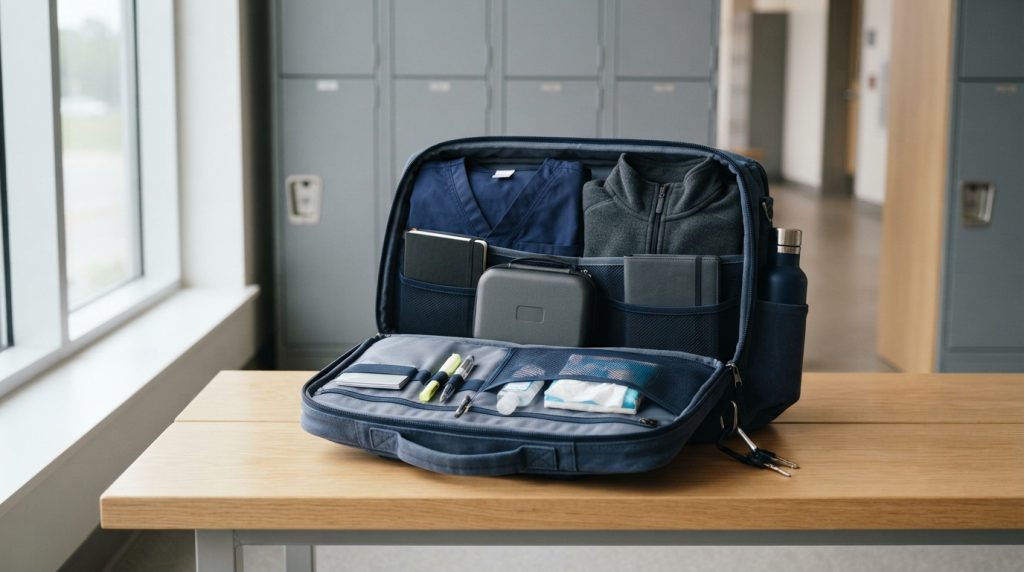
A dedicated scrub or healthcare work bag can organize items that do not need to remain in clothing pockets.
This can help reduce:
- Overloaded scrub pants
- Heavy scrub-top pockets
- Repeated searching
- Loose personal items
A practical work bag may hold approved items such as:
- Spare scrub set
- Jacket
- Personal water bottle where appropriate
- Notebook
- Personal-care items
- Sealed snacks for designated areas
- Work shoes
- Small organizer
- Stethoscope case
- Personal electronics
Actual contents should follow employer rules.
What Should You Look for in a Scrub Bag?
Useful features can include:
- Comfortable handles
- Shoulder strap
- Several organized compartments
- Stable base
- Secure closures
- Easy-access personal pocket
- Separate footwear area when available
- Interior organization
- Material appropriate for the intended use
The largest bag is not always the best one.
An oversized bag can encourage unnecessary packing.
Choose the Right Capacity
Ask what the bag needs to hold on a typical day.
If the answer is:
- Spare clothing
- Small personal items
- Notebook
- One protected work instrument
a moderate-size bag may be sufficient.
Someone moving between school and clinical placements may need more capacity.
Tote Bag vs Backpack for Healthcare Work
Both can work.
Tote-Style Bags
Potential advantages include:
- Wide opening
- Easy visibility of contents
- Quick access
- Simple organization
Possible disadvantages include:
- Weight carried primarily on one side
- Less comfortable longer-distance carrying
- Open designs may provide less security
Backpacks
Potential advantages include:
- Weight distributed across both shoulders
- Hands remain free
- Multiple compartments
- Comfortable longer-distance transport
Possible disadvantages include:
- Items may settle at the bottom
- Deep compartments can be harder to organize
- Bulky designs may be unnecessary for small loads
Choose according to the commute, load, and workplace storage available.
Should Work Shoes Go Inside a Scrub Bag?
If footwear is transported in the same larger bag as other items, a separate compartment or dedicated shoe pouch can keep it physically separated from clean personal belongings.
The specific handling of work footwear depends on:
- Workplace procedures
- Work environment
- Where shoes are worn
- Where they are stored
Avoid assuming that one storage practice is appropriate for every clinical setting.
Why Are Stethoscope Cases Useful?
A stethoscope case provides a dedicated storage location during transport or when the instrument is not being worn.
Potential benefits include:
- Protection from compression
- Reduced tangling
- Separation from loose bag contents
- More consistent organization
A case can be particularly useful for:
- Students
- Professionals commuting between locations
- Workers carrying several items in one bag
Hard vs Soft Cases
Hard or semi-rigid cases may provide greater protection from pressure.
Soft cases may:
- Use less space
- Weigh less
- Be easier to place inside a bag
The appropriate option depends on the specific equipment and manufacturer instructions.
Can a Stethoscope Be Stored Loose in a Scrub Bag?
It can be physically placed there, but loose storage may expose it to:
- Pressure from other objects
- Tangling
- Repeated bending
- Contact with unrelated bag contents
A dedicated compartment or suitable case provides more controlled storage.
Cleaning and handling should follow the equipment manufacturer’s instructions and workplace policy.
What Is a Pocket Organizer?
A pocket organizer is a small insert or holder designed to keep lightweight items separated inside a scrub pocket.
It may include spaces for:
- Pens
- Marker
- Small notebook
- Penlight
- Other workplace-approved small items
A good organizer can prevent several objects from becoming mixed together at the bottom of a large pocket.
Why Pocket Organization Matters
Without organization, the wearer may repeatedly remove several items just to find one.
A simple organizer can make access more predictable.
However, it should not encourage overloading.
If the organizer is filled until the pocket pulls outward, the storage system is too heavy or bulky.
What Should Be Kept in Scrub Pockets?
Only items that are:
- Necessary
- Lightweight
- Workplace-approved
- Appropriate for ordinary clothing storage
Possible examples include:
- Pens
- Small note card
- Small notebook
- Identification accessory
- Approved communication device
- Key
- Small personal item
The exact list varies by role and employer.
What Should Never Be Carried Loose in Scrub Pockets?
Contaminated sharps should never be treated as ordinary pocket items.
OSHA’s guidance on needlestick and sharps injuries emphasizes proper handling and disposal of contaminated sharps using appropriate controls and designated disposal systems.
Ordinary scrub or accessory pockets should not be used to loosely carry:
- Used needles
- Contaminated sharps
- Unprotected blades
- Leaking containers
- Unsecured specimens
- Items prohibited by workplace policy
A pocket organizer is an organizational accessory, not a sharps-storage device.
Are Pen Holders Useful?
Pen holders can be useful for professionals who frequently carry several writing instruments.
They may:
- Keep pens upright
- Reduce searching
- Prevent multiple pens from spreading throughout a pocket
- Separate a pen from personal items
Look for a holder that:
- Fits the pocket
- Does not create excessive thickness
- Can be emptied easily
- Does not distort the garment
A two- or three-slot organizer may be more practical than a large holder filled with unnecessary items.
Are Retractable Key Holders Practical?
A retractable key or card holder may help keep an approved access item attached to the uniform.
Potential uses include:
- Access card
- Approved key
- Small identification token
The attachment should remain secure.
Avoid an accessory that:
- Swings widely
- Adds significant weight
- Catches on surrounding objects
- Requires placement near patient-care tasks where it interferes
The workplace may also specify where access cards or keys must be kept.
Are Underscrubs Considered Scrub Accessories?
Underscrubs are an important layering accessory for many healthcare professionals.
They are typically worn beneath a short-sleeved scrub top to provide:
- Additional warmth
- Arm coverage
- Layering flexibility
Common options include:
- Long-sleeve underscrubs
- Short-sleeve base layers
- Lightweight stretch tops
What Should an Underscrub Feel Like?
A good base layer should:
- Fit smoothly beneath the scrub top
- Allow shoulder movement
- Avoid excessive bunching
- Remain comfortable around the neckline
- Add appropriate warmth without unnecessary bulk
Do Not Size the Scrub Top Without the Underscrub
If an underscrub will be worn regularly, test both garments together.
The added layer can change:
- Shoulder room
- Armhole fit
- Chest fit
- Temperature comfort
Can Long Sleeves Interfere With Clinical Work?
They can in some settings or tasks.
Sleeve requirements vary according to:
- Facility policy
- Department
- Procedure
- Infection-control practices
CDC emphasizes hand hygiene as a core infection-prevention practice for healthcare personnel.
Any garment or accessory worn around the wrist should not prevent the wearer from following required hand-hygiene and patient-care procedures.
Are Scrub Jackets Useful Accessories?
A scrub jacket provides a removable layer for healthcare professionals who work in changing indoor temperatures.
Useful features may include:
- Lightweight fabric
- Stretch
- Zip or snap front
- Knit cuffs
- Front pockets
- Appropriate sleeve length
A jacket can be especially practical when the wearer moves between:
- Cooler workstations
- Patient-care areas
- Administrative spaces
- Different buildings
A Jacket Should Remain Easy to Remove
A removable layer provides more flexibility than choosing an unnecessarily heavy base scrub top.
Test the jacket over the complete uniform.
Make sure it does not:
- Restrict shoulders
- Cover essential pockets
- Create excessive warmth
- Interfere with workplace requirements
Are Scrub Jackets Protective Equipment?
Ordinary scrub jackets and other fashion or comfort accessories should not be confused with PPE.
CDC Standard Precautions call for PPE based on anticipated exposure to infectious material. Depending on the task, this may include gloves, gowns, masks, eye protection, or other protective equipment.
A regular jacket, underscrub, or scrub cap should not be assumed to provide the protection required from task-specific PPE.
Are Work Socks an Important Scrub Accessory?
Socks are a basic part of the complete work uniform, although they receive less attention than tops and pants.
The best choice depends on:
- Work footwear
- Temperature
- Sock height preference
- Fabric preference
- Workplace requirements
A practical sock should remain in position without:
- Repeatedly sliding
- Bunching inside the shoe
- Creating uncomfortable seams
Healthcare workers considering specialized compression hosiery for a medical reason should follow appropriate healthcare guidance rather than treating medical compression as an ordinary fashion accessory.
Are Scrub Caps Useful?
Scrub caps or other approved head coverings may be required, permitted, or unnecessary depending on the work setting.
Common designs include:
- Traditional tie-back caps
- Bouffant-style coverings
- Ponytail styles
- Adjustable caps
The appropriate head covering depends on:
- Workplace policy
- Hair length
- Department requirements
- Procedure requirements
Fashion Cap vs Required Protective Covering
A personal scrub cap should not automatically be treated as equivalent to any head covering required for a specific clinical procedure.
Facility requirements determine which items are appropriate.
What Should You Look for in a Scrub Cap?
When personal caps are permitted, useful features may include:
- Secure fit
- Comfortable head circumference
- Appropriate hair coverage
- Adjustable ties
- Lightweight fabric
- Care instructions compatible with regular use
The cap should remain stable during movement without creating excessive pressure.
Are Hair Accessories Part of the Work Uniform?
For professionals with longer hair, workplace-approved hair accessories can support a controlled hairstyle.
Possible options include:
- Simple hair ties
- Clips
- Headbands
- Approved hair coverings
Avoid accessories that are:
- Loose
- Oversized
- Difficult to secure
- Inconsistent with the employer’s dress code
The goal is practical hair control rather than decorative complexity.
Should Healthcare Workers Carry a Small Notebook?
Some professionals find a small workplace-approved notebook useful for non-sensitive notes or reminders.
However, healthcare information should only be recorded and handled according to:
- Employer policy
- Privacy requirements
- Approved documentation procedures
A personal notebook should never become an unofficial substitute for required clinical documentation systems.
Choose a compact size that fits comfortably without distorting pockets.
What About Phones and Smartwatches?
Personal technology policies differ significantly across healthcare workplaces.
Before carrying or wearing:
- Personal phone
- Smartwatch
- Wireless earbuds
- Other electronic accessories
confirm the facility rules.
Consider:
- Whether the device is allowed in patient-care areas
- How it is stored
- Whether it interferes with gloves or hand hygiene
- How workplace-required cleaning procedures apply
Convenience should not override clinical or privacy policies.
How Should Accessories Be Chosen for Nurses?
Useful nurse scrub accessories often emphasize organization and easy movement.
A practical setup may include:
- Secure badge holder
- Small pocket organizer
- Work bag
- Stethoscope case
- Lightweight jacket
- Comfortable base layer
However, nursing specialties differ substantially.
A nurse with immediate workstation access may need fewer pocket accessories than someone who moves continuously between multiple rooms.
Which Accessories Are Useful for Nursing Students?
Students often need to carry more items between locations.
Useful categories may include:
- Structured work bag
- Backpack
- Stethoscope case
- Badge holder
- Pen organizer
- Spare scrub storage
- School-approved outerwear
Students should review program requirements before purchasing:
- Embroidered jackets
- Specific badge accessories
- Specialty scrub caps
- Color-coordinated items
Programs may regulate uniform colors and accessories.
Which Accessories Work Well for Doctors?
Doctors may prioritize a simpler setup, especially when wearing a lab coat.
Potentially useful items include:
- Badge holder
- Minimal pocket organizer
- Secure work bag
- Base layer
- Lightweight outer layer where appropriate
A lab coat already provides significant pocket storage, so adding numerous scrub-pocket organizers may create unnecessary duplication.
Which Accessories Are Useful for Medical Assistants?
Medical assistants may move between:
- Patient-facing work
- Documentation
- Administrative tasks
Useful accessories may include:
- Badge reel
- Small pen organizer
- Work bag
- Lightweight jacket
- Secure personal-item storage
The ideal setup should support both standing and seated work.
Which Accessories Are Useful in Dental Settings?
Depending on workplace policy, dental professionals may find value in:
- Secure identification holder
- Lightweight base layers
- Small work bag
- Simple hair-control accessories
Protective equipment required for dental procedures remains separate from ordinary uniform accessories.
Which Accessories Are Useful in Veterinary Settings?
Veterinary professionals may benefit from:
- Secure badge attachment
- Organized pockets
- Durable work bag
- Hair-control accessories
- Lightweight removable layer
Loose or dangling accessories may be less practical in environments involving active animals.
Security and controlled fit are particularly important.
How Many Accessories Should Be Carried During a Shift?
A simple rule is:
Carry what is needed regularly and store everything else elsewhere.
Before each shift, divide items into three groups.
On-Body Essentials
Items used repeatedly and permitted to remain in scrub pockets or attached securely to the uniform.
Bag Essentials
Items needed during the day but not continuously.
Nonessential Items
Objects that can remain:
- At home
- In a locker
- In a vehicle where appropriate
- In another approved location
This approach reduces both physical clutter and decision-making.
How Can Pocket Weight Be Reduced?
Start by emptying every pocket at the end of a shift.
Then assess each item.
Ask:
- Was this used today?
- Does it need to stay on the body?
- Is there a better storage location?
- Is it safe to carry this way?
- Could a bag or workstation hold it instead?
Even several small objects can create noticeable weight when combined.
Should Accessories Match Scrub Colors?
They can, but exact color matching is rarely essential unless required by the employer.
A simple accessory palette may include:
- Black
- Navy
- Gray
- Another workplace-approved neutral
Neutral accessories can coordinate with multiple scrub sets.
Bright colors or prints may also be appropriate when workplace policy permits them.
Function should come before color coordination.
Can Accessories Be Personalized?
Some items may be personalized with:
- Name
- Initials
- Department
- Organization logo
Potential items include:
- Work bags
- Jackets
- Badge accessories
Before customization:
- Confirm the item is approved.
- Verify spelling.
- Confirm logo permission.
- Approve placement.
- Check return restrictions.
Permanent customization should usually be added only after the underlying item has been tested.
How Should Scrub Accessories Be Organized at Home?
A dedicated workwear area can simplify preparation.
For example:
- Clean scrub sets together
- Badge and keys in one designated location
- Work bag packed with reusable essentials
- Stethoscope stored in its case
- Jacket hanging with the uniform
- Spare supplies stored separately
The goal is to reduce repeated searching before a shift.
How Often Should a Work Bag Be Cleaned?
There is no universal cleaning schedule for every work bag.
Cleaning depends on:
- Material
- Manufacturer instructions
- Where it is used
- Workplace procedures
- Whether visible soil is present
Choose a bag whose material and construction can be maintained according to its intended use.
Avoid assuming that any household disinfectant is appropriate for every textile or coated surface.
How Should Reusable Accessories Be Managed?
Reusable accessories should be maintained according to:
- Manufacturer instructions
- Employer policy
- Infection-control requirements
CDC’s infection-prevention guidance stresses appropriate handling and reprocessing of reusable medical equipment between patients or when soiled.
Not every scrub accessory is medical equipment, but the broader principle is useful: reusable items brought into patient-care environments should not be ignored simply because they are small or personal.
What Accessories Should Be Left Outside Patient-Care Areas?
This depends on workplace policy.
Potentially unnecessary items may include:
- Large personal bags
- Food containers
- Unapproved personal electronics
- Bulky outerwear
- Decorative accessories
Store them in designated locations whenever required.
Reducing unnecessary objects around active clinical work can also make the uniform easier to manage.
Are More Expensive Accessories Better?
Not automatically.
Evaluate value according to:
- Construction
- Durability
- Function
- Ease of use
- Compatibility with the workplace
- Frequency of use
An inexpensive badge reel that works reliably may provide more value than an elaborate model that is heavy or difficult to maintain.
Likewise, a simple work bag with good organization may perform better than a large premium bag filled with unnecessary compartments.
How Can Accessories Be Tested Before Buying?
Evaluate them in combination with actual workwear.

Badge Holder
Attach it to the scrub top and test:
- Walking
- Bending
- Sitting
- Jacket layering
Work Bag
Load it with typical items and:
- Lift it
- Carry it
- Walk with it
- Open the compartments
Pocket Organizer
Place it inside the intended pocket.
Confirm that:
- The pocket does not bulge excessively
- Items remain accessible
- The organizer does not pull the garment
Jacket
Wear it over the normal scrub top and test shoulder movement.
Stethoscope Case
Confirm:
- Instrument fits without being forced
- Closure works easily
- Case fits inside the work bag
Professionals who prefer evaluating bags, organizers, layers, and other workwear items alongside their uniforms can visit a medical scrub store in Lincoln before purchasing a larger accessory setup.
How Should Accessories Be Bought Online?
When shopping for scrubs and accessories, review the actual dimensions rather than relying only on product photos.
For bags, check:
- Width
- Height
- Depth
- Strap length
- Compartment layout
For cases, check:
- Internal dimensions
- Closure
- Construction
For wearable accessories, check:
- Attachment method
- Weight
- Length
- Material
- Care instructions
Read the Return Policy
Accessory fit can be difficult to judge from a screen.
Make sure the item can be returned before:
- Personalizing it
- Embroidering it
- Removing permanent tags
- Using it extensively
Common Scrub Accessory Buying Mistakes
Buying Too Many Accessories
More items can create more clutter instead of better organization.
Choosing Accessories Before Checking Workplace Policy
An attractive item has little value if it cannot be used at work.
Overloading Scrub Pockets
Pockets should not function as a substitute for a work bag.
Using Ordinary Pockets for Hazardous Items
Contaminated sharps require proper handling and disposal.
Choosing a Huge Work Bag
Extra capacity often becomes extra weight.
Ignoring Cleaning and Maintenance
Frequently handled accessories may require regular inspection and workplace-appropriate maintenance.
Selecting Long Dangling Accessories
They may interfere with movement or nearby surfaces.
Treating Ordinary Accessories as PPE
Scrub jackets, caps, bags, and similar items do not replace required protective equipment.
Personalizing Before Testing
Customized products can become difficult to exchange.
Matching Colors Before Evaluating Function
An accessory should solve a practical need first.
Practical Scrub Accessory Checklist
Identification
- Badge holder is secure
- Identification remains visible
- Retractable mechanism works
- Attachment does not damage the scrub top
Pocket Organization
- Only necessary items are carried
- Pocket organizer fits without bulging
- Weight is distributed
- Hazardous items are stored appropriately elsewhere
Work Bag
- Capacity matches daily needs
- Compartments are useful
- Carrying method is comfortable
- Personal and work items can be organized
- Material is practical for the intended environment
Equipment Storage
- Protective case fits the intended item
- Closure works reliably
- Case fits inside the work bag
- Equipment can be removed without forcing it
Layering
- Underscrub fits beneath the uniform
- Jacket allows shoulder movement
- Sleeves do not interfere with work
- Layers remain appropriate for facility policy
Workplace Requirements
- Accessories comply with dress code
- Hand hygiene remains unobstructed
- Required PPE can be used correctly
- Personal electronics follow workplace policy
- Cleaning and handling requirements are understood
Conclusion
The best scrub accessories are practical, lightweight, secure, and appropriate for the workplace.
For many healthcare professionals, a useful accessory setup may include:
- Secure badge holder
- Organized work bag
- Protective equipment case
- Simple pocket organizer
- Appropriate base layer
- Lightweight scrub jacket
The exact combination should match the role rather than a generic checklist.
Accessories should reduce clutter, not create it. They should support identification and organization without interfering with movement, hand hygiene, required PPE, or workplace safety procedures.
Before adding another item to a uniform, ask one question:
Does this accessory make the workday simpler?
If the answer is no, it probably does not need to be carried.
Frequently Asked Questions
What are the most useful scrub accessories for nurses?
Commonly useful options include a secure badge holder, small pocket organizer, work bag, stethoscope case, underscrub, and lightweight jacket. The best combination depends on the nurse’s department, workplace policies, storage access, and daily responsibilities.
What should healthcare workers keep in scrub pockets?
Scrub pockets are best used for necessary, lightweight, workplace-approved items such as pens, identification accessories, a small notebook, or approved communication devices. Hazardous items such as contaminated sharps require designated handling and disposal.
Is a scrub bag better than carrying everything in pockets?
A work bag can keep items that are not needed continuously out of the uniform pockets. This may reduce garment weight and clutter while providing organized storage for spare clothing, personal items, and protected equipment.
Are badge reels appropriate for healthcare workers?
Badge reels can be practical when permitted by the employer. The reel should remain secure, keep identification visible, and avoid excessive dangling or interference with patient-care activities.
Do scrub accessories need to match the uniform?
Not necessarily. Matching colors can create a coordinated appearance, but function and workplace requirements matter more. Neutral accessories are often easy to use with multiple scrub colors.
Are scrub jackets and caps considered PPE?
Ordinary scrub jackets and personal scrub caps should not automatically be considered PPE. Required protective equipment is selected according to anticipated exposure and workplace protocols.