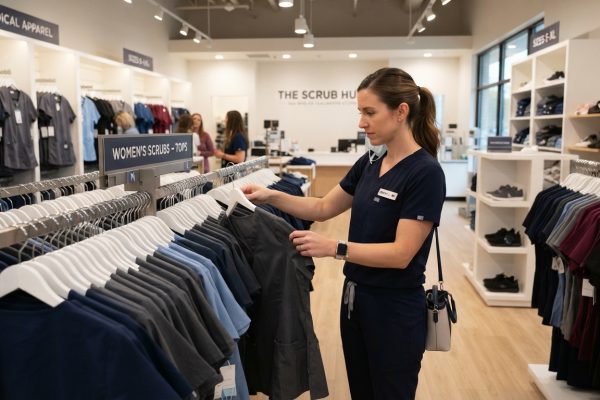

The best scrubs for nurses, doctors, and other healthcare professionals are not defined by one fabric, fit, or pant style. The right choice depends on the worker’s duties, movement, workplace dress code, storage needs, and preferred fit. Professionals comparing the best scrubs for women should evaluate how each garment performs during their actual workday rather than choosing only by appearance.
A nurse who spends much of a shift moving between patients may need different pocket and mobility features than a physician working in an outpatient office. Medical assistants may alternate between clinical and administrative tasks. A practical scrub wardrobe starts with the job.
Quick Answer
The best scrubs for healthcare professionals should match four things: workplace requirements, job duties, body proportions, and normal shift movement.
In general, consider:
- Stretch and freedom of movement
- Appropriate top and pant fit
- Practical pocket placement
- Correct inseam and pant rise
- Workplace color requirements
- Fabric weight and layering needs
- Ease of routine garment care
- Professional appearance
- Availability of approved team styles
- Whether jackets or lab coats are part of the uniform
Nurses often prioritize movement and accessible storage. Doctors may prefer streamlined professional fits or garments that work well with lab coats. Medical assistants may benefit from versatile scrubs that transition between clinical and desk-based duties.
No single scrub is objectively best for every healthcare profession.
Why should healthcare professionals choose scrubs by job role?
Healthcare occupations can look similar from a distance, but daily duties differ significantly.
The U.S. Bureau of Labor Statistics notes that registered nurses provide and coordinate patient care and may be on their feet for much of a shift. Physical stamina is specifically identified as important because nursing can involve physical tasks.
Physicians and surgeons work across clinical and nonclinical environments, including hospitals and physicians’ offices. Medical assistants can perform a combination of administrative and clinical tasks, with duties varying according to employer, specialty, and location.
These differences help explain why choosing scrubs only by color or trend can be limiting.
A useful question is:
What does the wearer repeatedly do during a normal workday, and which clothing features support those activities without constant adjustment?
That question is more practical than asking which scrub brand or silhouette is universally “best.”
What should nurses look for in medical scrubs?
Nurses often work in environments where movement, storage, and long periods on their feet influence clothing preferences.
The Bureau of Labor Statistics profile for registered nurses describes nursing as a role that can require physical tasks and substantial time standing. This makes movement testing especially useful when evaluating scrub fit.

Prioritize unrestricted everyday movement
A scrub top should allow the wearer to reach forward and raise the arms without severe pulling through the shoulders or upper back.
Scrub pants should be tested while:
- Walking
- Sitting
- Bending the knees
- Reaching toward a low surface
- Moving from sitting to standing
The clothing should not be presented as injury-prevention equipment. However, normal workwear should be appropriately fitted for the activities the wearer routinely performs.
NIOSH emphasizes safe patient handling and mobility technology when workers are moving or handling patients. The NIOSH safe patient handling guidance explains the role of assistive lifting devices and proper safe patient handling practices. Scrub stretch should never be described as a replacement for those workplace controls.
Choose pockets according to actual nursing duties
Nurses may prefer tops or pants with several storage areas, but a high pocket count is not automatically better.
Consider:
- Which approved items are carried
- Whether items need frequent access
- Whether chest pockets become overloaded
- Whether cargo pockets affect pant balance
- Whether zippered storage is needed for small personal items
A three-pocket garment with well-positioned storage can be more useful than a seven-pocket garment when several compartments are difficult to reach.
Evaluate scrub pants for long periods of movement
Joggers, tapered pants, straight-leg styles, and flare pants can all work for nursing.
The better choice depends on the wearer.
Joggers may appeal to nurses who want less loose material around the ankle. Straight-leg styles offer a traditional silhouette and more calf room. Tapered pants create a streamlined shape without necessarily using an ankle cuff.
The waistband also matters. Full elastic, drawstring, yoga-style, and combination waistbands can feel different after repeated sitting and standing.
What are the best scrubs for doctors?
Doctors work in a wide range of settings, so there is no single “doctor scrub” design.
According to the BLS occupational profile for physicians and surgeons, physicians may work in clinical environments such as hospitals and medical offices as well as nonclinical settings.
Scrub needs can therefore differ by specialty and workplace.

Clinical movement should influence fit
A physician working in a hospital may prioritize movement, practical pockets, and easy layering.
An outpatient physician may prefer a more structured scrub silhouette that maintains a coordinated appearance in an office setting.
The core fit requirements remain similar:
- Shoulder movement should feel natural
- The top should provide appropriate coverage
- Pants should remain secure when sitting and walking
- The inseam should suit the intended pant style
- Pockets should support actual work needs
Healthcare professionals reviewing men’s professional scrubs can compare scrub tops, pants, joggers, and related workwear categories according to the demands of the role rather than assuming all men’s scrubs fit or function identically.
Consider how scrubs work with a lab coat
Physicians and other professionals who regularly wear lab coats should evaluate scrubs as part of a layered outfit.
A bulky scrub top may feel different beneath a fitted coat. A chest pocket filled with large items may also affect how a lab coat sits.
When possible, test the planned layers together.
Check:
- Shoulder movement
- Sleeve comfort
- Fabric bunching
- Overall temperature comfort
- Access to necessary pockets
Scrubs and lab coats should work together rather than being selected as completely separate clothing decisions.
What should medical assistants look for in scrubs?
Medical assistants often require versatile workwear because their duties can include both administrative and clinical tasks.
The BLS medical assistant profile notes that medical assistants may schedule appointments and complete other administrative work while also performing clinical duties such as taking vital signs.
This type of mixed workday can make balanced scrub features especially useful.
Choose scrubs that transition between tasks
A medical assistant may move from a desk or front-office area to a patient care environment.
Useful scrub characteristics may include:
- Comfortable seated fit
- Professional overall appearance
- Moderate stretch
- Accessible pen storage
- Practical lower pockets
- A secure waistband
- Easy layering
The garment should be assessed during both sitting and movement.
A waistband that feels fine while walking may create pressure during desk work. A top that looks structured while standing may pull across the shoulders during clinical tasks.
Avoid unnecessary pocket bulk
Medical assistants should identify what they actually carry.
Large cargo storage may not be necessary for every role. In some practices, a simple top with accessible pockets may provide enough storage.
Uniform selection should follow the job rather than an assumption that every clinical worker needs the same pocket configuration.
What should CNAs and patient care staff prioritize?
CNAs and other direct patient care staff may experience active workdays with repeated movement.
Scrubs should be evaluated for:
- Hip and thigh mobility
- Knee movement
- Secure waistbands
- Appropriate top coverage
- Useful pocket placement
- Correct pant length
Patient movement and handling should always follow workplace safety practices and appropriate assistive methods. NIOSH identifies safe patient handling and mobility technology as an important approach for helping healthcare workers with patient handling tasks.
A stretchy scrub fabric is a clothing feature. It is not an ergonomic control or substitute for required patient-handling equipment.
Why secure fit matters
Clothing that repeatedly slips or shifts can become distracting during active work.
Check whether:
- The waistband stays in position
- The top requires repeated pulling down
- Pocket weight causes one side to sag
- Pant hems interfere with walking
- The knees feel restricted when bending
The best-fitting scrub is often the one that demands the least attention while normal job duties are being performed.
What scrubs work well for healthcare office teams?
Healthcare offices may have a different priority: creating a consistent professional appearance while still allowing employees to choose appropriate fits.
A dental office, specialty clinic, veterinary practice, or outpatient medical office may include employees with different body proportions and responsibilities.
Trying to put every employee into one identical top and pant style can create unnecessary fit problems.
A more flexible approach to scrubs for healthcare teams may involve selecting an approved color, brand, or collection while allowing staff to choose from designated tops and pants.

Consistency does not require identical fits
A team uniform program can standardize:
- Color
- Approved collection
- Embroidery or branding
- General appearance requirements
- Jacket or outerwear rules
At the same time, employees may need different:
- Top sizes
- Pant sizes
- Inseams
- Rises
- Leg silhouettes
- Maternity options
A coordinated team can still maintain a professional appearance without requiring every person to wear the exact same pant shape.
Consider the actual staff roles
Front-office employees may sit more frequently.
Clinical staff may move between rooms.
Medical assistants can perform mixed administrative and patient-facing tasks. Physicians and advanced practice professionals may wear lab coats over scrubs.
A good uniform program considers these differences before approving styles.
Which scrub fabric is best for healthcare professionals?
There is no universally best scrub fabric blend.
Healthcare professionals should focus on how the fabric behaves in their environment and role.
Stretch
Stretch can support normal garment movement during bending and reaching.
However, stretch cannot correct:
- An incorrect inseam
- A waistband that is too large
- An unsuitable rise
- A top that is poorly proportioned for the wearer
Fabric performance and garment fit should be evaluated together.
Weight
Lightweight fabrics may appeal to professionals working in warm environments or those who prefer less garment weight.
More structured fabrics may appeal to workers who prefer a crisp silhouette.
Personal preference matters, but layering should also be considered.
Drape
Drape describes how fabric hangs and moves on the body.
A soft fabric may create a fluid silhouette. A more structured fabric may maintain a defined shape.
Neither is automatically more professional. The garment still needs to meet workplace requirements and fit appropriately.
Care instructions
Healthcare workers should review manufacturer care instructions before buying several sets.
Consider:
- Recommended wash temperature
- Drying instructions
- Whether special fabric treatments require specific care
- Whether the garment works with the wearer’s normal laundry routine
Workplace policies should also be followed when uniforms are contaminated or require special handling.
Which scrub style is best for long healthcare shifts?
The best style for a long shift is usually the one that remains appropriately positioned and requires minimal adjustment.
Consider the following features:
A stable waistband
The waistband should not repeatedly slide downward or require extreme drawstring tightening.
Correct rise
The rise should allow sitting and bending without significant pulling or loss of coverage.
Appropriate inseam
Excessively long pants can gather at the ankle or floor. Pants that are too short may not provide the intended fit.
Comfortable shoulder fit
Scrub tops should allow ordinary reaching movements without severe tightness across the back.
Functional pockets
Pocket placement should match actual use.
Suitable fabric weight
The fabric should work with the workplace temperature and normal layering routine.
The word “comfortable” is subjective. Scrub comfort is usually the combined result of size, garment proportion, fabric, waistband, pocket load, and job movement.
Are jogger scrubs good for nurses and doctors?
Jogger scrubs can work well for nurses, doctors, medical assistants, and other healthcare professionals who prefer a tapered leg and fitted ankle.
Advantages may include:
- Less loose fabric around the ankle
- A modern silhouette
- A defined pant length
- Easy pairing with athletic-style work shoes
However, the calf and cuff need to fit comfortably.
A jogger that pulls through the calf or knee may feel restrictive during movement.
Straight-leg or tapered pants may be preferable for professionals who want additional lower-leg room or do not like ankle cuffs.
The profession alone does not determine the best pant style.
How many scrub sets does a healthcare worker need?
There is no universal answer.
A practical scrub rotation depends on:
- Number of workdays
- Consecutive scheduled shifts
- Laundry frequency
- Workplace uniform requirements
- Whether uniforms may need to be changed
- Personal preference for backup clothing
Someone working three scheduled days may still prefer more than three sets to create flexibility around laundry and unexpected clothing changes.
The better approach is to build a wardrobe around the actual work and washing schedule.
Should healthcare professionals buy matching scrub sets?
Matching sets are useful for color coordination, but tops and pants do not always need to be purchased in the same size.
Many healthcare workers have different upper- and lower-body proportions.
Separates make it possible to select:
- Different top and pant sizes
- A tuckable top with high-rise pants
- A relaxed top with joggers
- A traditional top with straight pants
- A maternity top with an appropriate maternity pant
When workplace color matching matters, selecting pieces from the same approved collection may make coordination easier.
Common mistakes healthcare professionals make when choosing scrubs
Choosing only by profession
Not every nurse has the same workday. Not every physician works in the same clinical environment.
Consider actual duties.
Buying a larger size to get more length
A tall or longer inseam option may solve the problem more effectively.
Choosing the highest pocket count
Pocket location and depth are more important than the number alone.
Ignoring seated comfort
Medical assistants, physicians, and office-based clinical staff may spend meaningful periods sitting.
Test the waistband and rise in a chair.
Assuming stretch solves every fit problem
Stretch does not correct an incorrect size, rise, or inseam.
Buying several sets before testing the fit
When trying an unfamiliar cut or collection, evaluate the fit and movement before building a full work wardrobe.
Ignoring team uniform requirements
Confirm approved colors and style rules before purchasing.
A practical scrub selection checklist by profession
Nurses
Prioritize:
- Movement
- Practical storage
- Secure waistband fit
- Correct inseam
- Layering needs
Doctors and physicians
Prioritize:
- Clinical environment
- Professional silhouette
- Mobility
- Lab coat compatibility
- Practical pocket needs
Medical assistants
Prioritize:
- Seated and standing comfort
- Versatility
- Accessible storage
- Professional appearance
- Easy movement between tasks
CNAs and patient care staff
Prioritize:
- Hip and knee movement
- Secure fit
- Appropriate coverage
- Practical pockets
- Correct pant length
Healthcare office teams
Prioritize:
- Color coordination
- Approved styles
- Inclusive fit options
- Role-specific garments
- Consistent branding requirements
Professionals who prefer to compare different scrub fits and workwear categories in person can also visit a local medical uniform store in Wilmington when evaluating options for individual or workplace needs.
How to choose the best scrubs for your healthcare role
Use this step-by-step process:
- Check the workplace uniform policy. Confirm colors, logos, outerwear, and approved styles.
- List the main duties of the role. Consider sitting, walking, bending, reaching, and patient-facing activities.
- Identify real storage needs. Count the items normally carried and determine the most useful pocket locations.
- Choose the correct overall size. Evaluate shoulders, waist, hips, and thighs.
- Select the right pant length. Compare petite, short, regular, and tall options where available.
- Choose a pant silhouette. Consider jogger, tapered, straight, or flare styles.
- Evaluate fabric preferences. Review stretch, weight, drape, and layering.
- Test realistic movement. Sit, walk, reach, and bend.
- Try the full work outfit. Add normal underscrubs, jackets, lab coats, and work shoes where relevant.
- Build a practical rotation. Buy enough approved sets to work with the normal schedule and laundry routine.
Final Thoughts
The best scrubs for nurses, doctors, and healthcare professionals are determined by the work being performed, not by a single universal ranking.
Nurses may place greater emphasis on movement and accessible storage. Doctors may need scrubs that balance clinical function with layering and professional appearance. Medical assistants often need versatile uniforms for mixed clinical and administrative tasks. Healthcare teams must also consider consistent colors and inclusive fit options.
The most useful scrub buying strategy is to start with workplace rules, identify the normal duties of the role, and then evaluate fit, inseam, rise, fabric, and pocket placement.
A good scrub should support the wearer’s normal workday without becoming a repeated source of adjustment or distraction.
Frequently Asked Questions
What are the best scrubs for nurses?
The best scrubs for nurses provide an appropriate workplace fit, allow normal movement, and offer practical storage for approved work items. Nurses should consider waistband security, pocket placement, inseam, shoulder movement, and fabric preferences according to their specific unit and duties.
What scrubs are best for doctors?
Doctors should choose scrubs according to their specialty and work environment. Clinical movement, professional appearance, useful storage, and compatibility with lab coats or jackets may all matter. Hospital-based and outpatient physicians may have different clothing priorities.
Should healthcare workers wear loose or fitted scrubs?
Scrubs should allow normal sitting, walking, reaching, and bending without excessive pulling or constant slipping. Extremely tight or overly loose garments can create fit problems. The appropriate fit depends on body proportions, garment cut, fabric, and workplace requirements.
Are jogger scrubs good for healthcare workers?
Jogger scrubs can be suitable for healthcare workers who prefer a tapered leg and fitted ankle cuff. They should provide enough room through the hips, thighs, knees, and calves for normal movement. Straight-leg and tapered styles remain practical alternatives.
How should a medical office choose scrubs for staff?
A medical office should first establish color, branding, and workplace requirements. It can then provide approved style options that account for different sizes, inseams, job roles, and fit preferences. Coordinated team uniforms do not necessarily require every employee to wear an identical top and pant silhouette.